


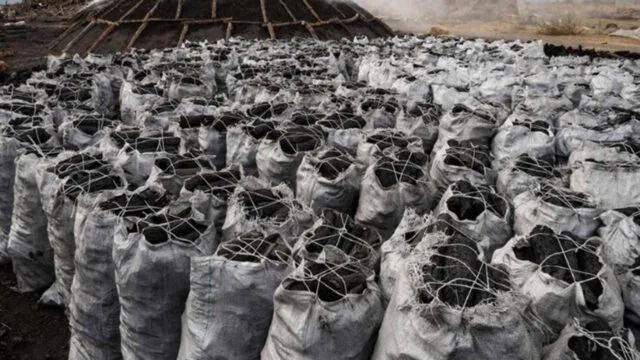
EKITI, Nigeria – Every bag of charcoal sold in Nigeria tells two stories: one of households and small businesses struggling to afford cooking fuel, and another of trees disappearing from forests to sustain a growing trade. As demand rises, the cost is being paid in damaged ecosystems, threatened water resources and exposure to smoke that can harm human health. For charcoal producers and traders, the business offers a means of survival. But as forests come under increasing pressure, environmental experts warn that Nigeria risks exchanging short-term economic relief for long-term damage to its climate, agriculture and public health. In this report, Korede Abdullah examines the booming charcoal trade, the communities and businesses sustaining it, and the environmental price of Nigeria’s dependence on the fuel.
The Business Behind Nigeria’s Disappearing Forests
Charcoal remains an important cooking fuel across Nigeria, particularly among households and small businesses unable to afford alternatives such as liquefied petroleum gas (LPG) and electricity.
The trade supports a chain of producers, transporters and retailers, providing income for rural communities while supplying affordable fuel to urban consumers. For many people, however, charcoal production is more than a commercial activity. It is a means of economic survival amid rising living costs and limited employment opportunities.
Damilola Fatai, who operated a charcoal business at Ikoyi farms in Ikole Local Government Area of Ekiti State, told Africa Health Report that he entered the business because it offered an opportunity to earn money. His experience reflects the economic realities driving the trade, even as increasing demand places pressure on forests, particularly where trees are felled without adequate replacement.
Nigeria’s Conservator-General of the National Park Service, Ibrahim Goni, has reportedly warned that the country loses more than 300 hectares of forest reserves daily. The figure highlights concerns about deforestation, although its geographical coverage and methodology require confirmation. Commercial charcoal production contributes to this pressure because wood remains its primary raw material.
Charcoal Production Threatens Rivers and Farmlands
The environmental consequences of indiscriminate tree felling extend beyond disappearing forests. A senior officer of the Ekiti State Ministry of Agriculture, Joseph Olayanju, warned that commercial charcoal production threatens indigenous trees, water resources, agricultural activities and rural livelihoods.
Speaking exclusively with Africa Health Report, Olayanju identified Ijabo farmland along Orunmeru in Igbemo-Ekiti, where the Oshin and Origi rivers are located, as an area requiring environmental protection.
He explained that producers often target mature indigenous hardwoods because of their suitability for charcoal production. “The problem is that they often prefer mature indigenous hardwoods because of their quality and suitability for charcoal production. When these trees are continuously removed without replacement, the forest gradually loses its natural vegetation,” he said.
Olayanju warned that removing trees around rivers exposes riverbanks to erosion and increases sedimentation. “Trees play an important role in protecting water resources. When trees around riverbanks are removed, the soil becomes exposed to erosion. Rainwater can wash sand and other sediments into the rivers, making them shallow and affecting water quality,” he explained.
For communities that depend on these rivers for domestic activities and farming, the consequences could threaten access to water and agricultural productivity. The loss of vegetation also exposes surrounding farmland to soil erosion and declining soil fertility, weakening the natural systems that support rural livelihoods.
The Climate Cost of Nigeria’s Charcoal Trade
Beyond local environmental damage, deforestation contributes to climate change. Trees absorb carbon dioxide and store carbon in their trunks, branches, roots and surrounding soil. When forests are cleared or degraded, their capacity to absorb and store carbon declines. Charcoal production also releases greenhouse gases and other pollutants through the burning of wood.
Olayanju warned that continued deforestation could contribute to rising temperatures, unpredictable rainfall, prolonged dry spells and declining soil moisture. “If we continue cutting down trees without replacing them, the consequences will affect our farms, rivers, communities and future generations,” he cautioned.
He added that forest destruction threatens biodiversity, increases erosion and reduces soil fertility. For farmers, these changes could translate into declining agricultural productivity, particularly in communities dependent on healthy soils, reliable water resources and favourable weather conditions.
The scale of the problem is therefore not limited to the number of trees being felled. It also concerns how quickly forests can regenerate and whether harvesting practices allow ecosystems to recover.
Affordable Charcoal Comes With Health Risks
While rural producers depend on charcoal for income, urban traders continue to sustain demand because of its affordability and convenience.
Around Lagos State University, Ojo, Esther Akintunde, a roasted corn seller, relies on charcoal to prepare food for her customers. “I use charcoal because it is what I can afford for my business. Buying cooking gas would increase my expenses and reduce the money I make from selling corn,” she said.
Another trader, Risikat Tajudeen, who sells roasted plantain, also depends on charcoal. “Charcoal is convenient for roasting plantain, and I can buy the quantity I need without spending too much money,” she said.
Their experiences illustrate why switching to alternative cooking fuels remains difficult for small businesses operating on narrow profit margins. However, the affordability of charcoal comes with public health concerns. Smoke from burning charcoal contains fine particulate matter and other harmful pollutants. In poorly ventilated spaces, incomplete combustion can also produce dangerous levels of carbon monoxide, an odourless and potentially fatal gas.
The World Health Organization has linked household air pollution from polluting cooking fuels and technologies to respiratory and cardiovascular diseases.
People who cook or work around burning charcoal may face prolonged exposure, particularly in poorly ventilated environments. Women, children and people with existing health conditions can be particularly vulnerable. The situation highlights the need to make cleaner cooking alternatives affordable and accessible to low-income households and small businesses.
Ekiti Forestry Laws Face Enforcement Challenges
Ekiti State has legal provisions designed to regulate forestry activities and prevent the indiscriminate exploitation of forest resources. Olayanju identified the Ekiti State Forestry Law, 2016, and the Ekiti State Environmental Protection Agency Law, 2009, as key frameworks for protecting natural resources.
He said commercial charcoal producers, chainsaw operators and timber contractors are expected to obtain appropriate registration and permits. Logging and sawmill activities are also restricted between 7:00 p.m. and 6:00 a.m. and prohibited on Sundays, he explained.
According to Olayanju, unauthorised tree felling and encroachment into protected forest reserves attract penalties, including fines, equipment seizure and imprisonment. Regeneration levies also support the Forest Trust Fund.
However, the existence of these laws does not automatically guarantee effective forest protection. Without adequate monitoring, enforcement and community participation, illegal and unsustainable activities can continue despite regulatory provisions.
The effectiveness of the regulations will depend on whether forestry officials have sufficient resources to monitor reserves, identify violations and hold offenders accountable.
Government, Communities Urged to Protect Forests
Olayanju said Governor Biodun Oyebanji’s administration was promoting forest regeneration through tree planting, seedling distribution and efforts to strengthen forestry personnel.
He identified the Ekiti State Forestry Commission, headed by Executive Secretary Otunba Sunday David Adekunle, as responsible for protecting forest reserves, monitoring logging activities and enforcing forestry regulations.
However, environmental protection requires more than periodic tree-planting campaigns. Newly planted seedlings must survive and mature before they can provide the ecological benefits of established forests. Olayanju called on traditional rulers, farmers and residents to participate in protecting the environment by reporting illegal charcoal production and discouraging the destruction of indigenous trees. “Making money from timber and charcoal should not mean destroying the environment and depriving future generations of its benefits,” he said.
His warning captures the difficult balance between economic survival and environmental protection. Charcoal provides income for rural producers and affordable cooking fuel for households and small businesses. But these economic benefits cannot justify uncontrolled deforestation or prolonged exposure to harmful smoke. Nigeria needs stronger forestry enforcement, sustainable charcoal production, investment in forest regeneration and affordable cleaner cooking alternatives.
The solution is not simply to shut down a trade that supports livelihoods. It is to ensure that production does not destroy the natural resources on which those livelihoods depend. Until these measures become practical realities, Nigeria risks paying a much higher environmental and public health price for the charcoal that offers temporary economic relief today.




Join the conversation