
Airport Staff Trained in Basic Life Support as Public Defibrillator Installed
 Otamere Gladness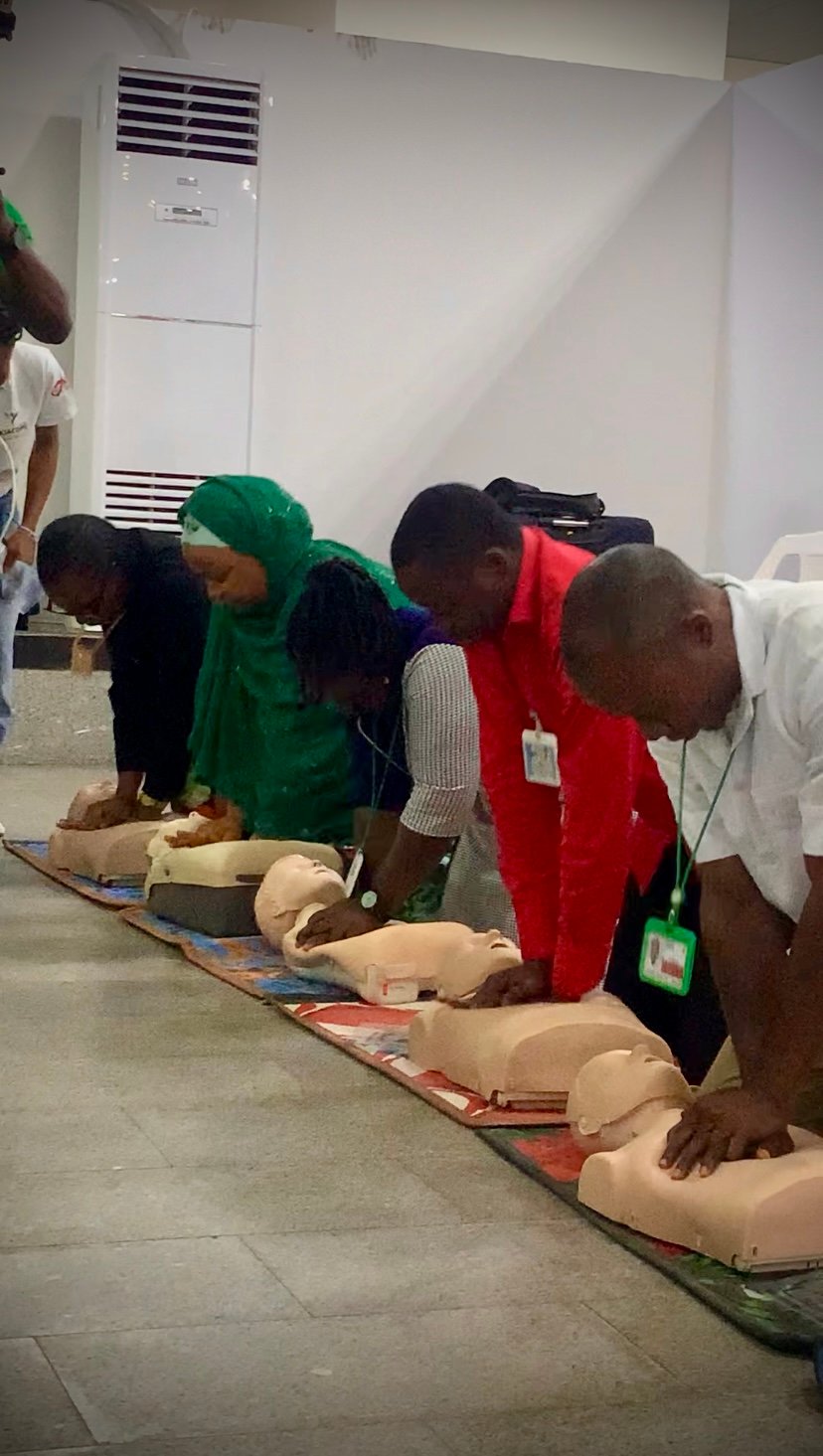
Trainees practicing what they have been taught
ABUJA, Nigeria – Airport personnel have undergone comprehensive Basic Life Support (BLS) training following the donation and installation of a public Automated External Defibrillator (AED), in a move aimed at strengthening emergency response and improving survival chances during cardiac emergencies.
The training, held on Monday, was organised by the Society for Public Health and Social Development in collaboration with Nizamiye Hospital, which donated the public defibrillator installed at the airport.
Participants were taught that victims of cardiac arrest are typically unresponsive, have no detectable pulse and are not breathing. However, where a patient has a pulse but is unconscious and not breathing, rescuers should prioritise assisted ventilation instead of chest compressions.
The training emphasised that emergency responders must first ensure scene safety before assessing the victim by checking responsiveness, pulse and breathing, while activating emergency medical services through the national emergency number, 112, to request an ambulance and an AED.
Trainees also received hands-on instruction in high-quality cardiopulmonary resuscitation (CPR), including maintaining compression rates of 100–120 compressions per minute with recommended compression depths for adults, children and infants using the standard 30:2 compression-to-ventilation ratio.
Speaking during the event, President of the Nigeria Cardiac Society, Prof. Austin Odili commended the sponsors for donating the life-saving equipment and urged participants to take the training seriously.
He stressed that every airport worker—not only doctors and nurses—should possess Basic Life Support skills capable of saving lives during emergencies.
“Our goal is for everyone working at the airport to know Basic Life Support so that we won’t continue to lose our loved ones,” he said.
According to facilitators, cardiovascular diseases account for between 50 and 75 per cent of deaths in Nigeria, highlighting the urgent need to improve public access to emergency life-saving interventions.
About the Author


 Mirian Gom

 Korede Abdullah
 Oluwatobi Adu