
After the Airstrikes: Inside the Nigeria-US Hunt That Killed ISWAP’s Shadow Commander —Fear of Bloody Revenge
 Oluwafunbi Bello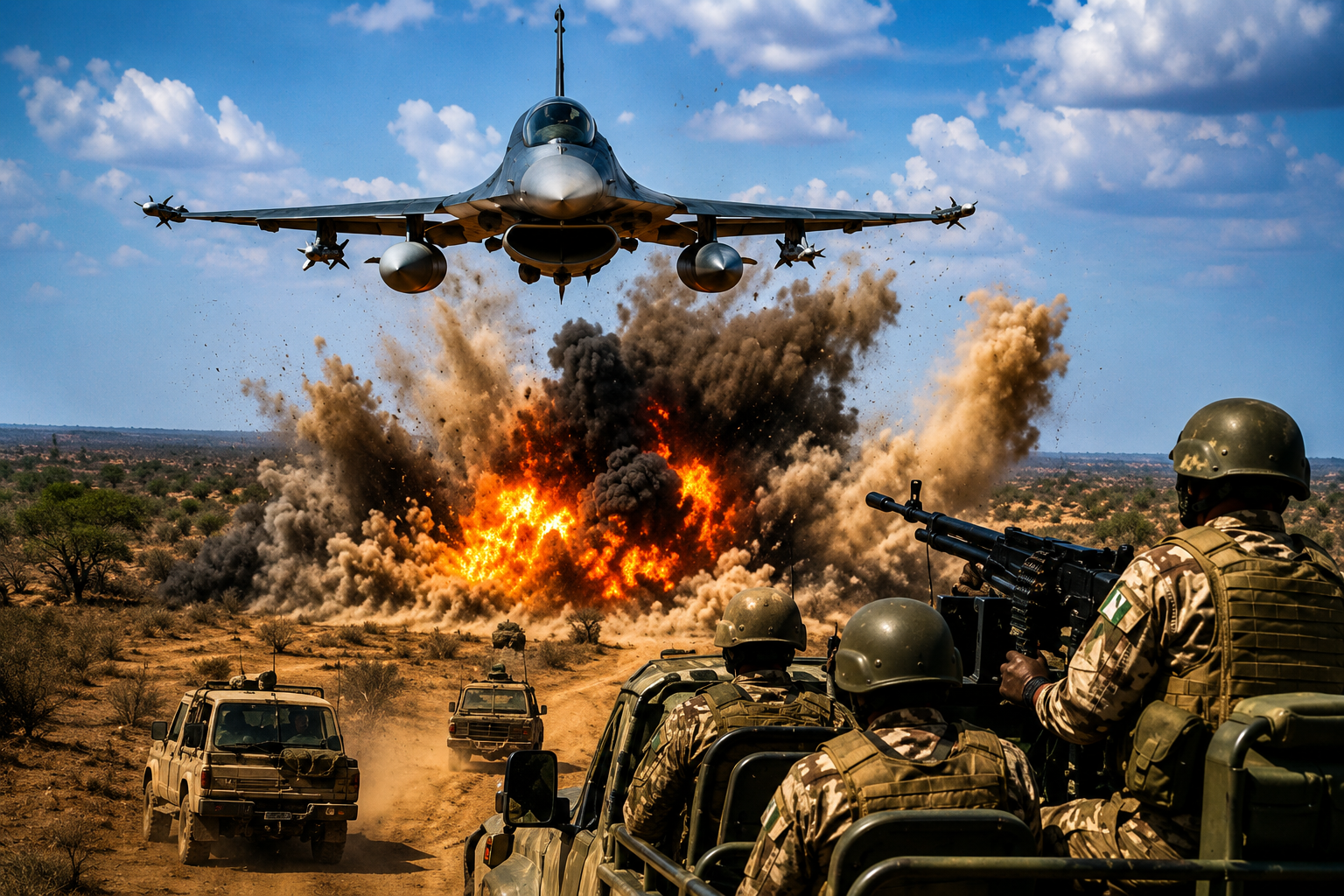
ABUJA, Nigeria – Deep inside the marshlands of the Lake Chad Basin, where Nigeria’s insurgency war has dragged on for more than a decade, a coordinated Nigerian-American military offensive tore through suspected Islamic State West Africa Province (ISWAP) hideouts with deadly precision. The operation killed one of the group’s most feared commanders, Abu-Bilal al-Minuki, in what security analysts now describe as one of the most consequential counterterrorism strikes in recent years. Yet beneath the celebration lies a darker fear: that the death of a senior jihadist leader could trigger another wave of revenge attacks across Nigeria’s already battered North-East. Oluwafunbi Bello, writes.
The May 16 operation, carried out around Metele in Borno State, marked a rare high-profile collaboration between Nigerian forces and the United States military. American authorities later confirmed that Abu-Bilal al-Minuki — also known as Abu Bakr al-Mainuki — was among those killed during the strikes.
According to the United States Africa Command, al-Minuki was not merely a local field commander. He was described as a senior ISIS-linked operative responsible for coordinating international logistics, propaganda, explosives development and drone operations for extremist networks operating across West Africa.
For Nigeria, a country that has spent years battling insurgent violence, the announcement represented both a symbolic and strategic victory.
But analysts warn that in the shifting landscape of extremist warfare, killing a commander rarely means ending the insurgency itself.
A Tactical Victory in a Long War
Nigerian military authorities said follow-up operations after the initial assault destroyed multiple ISWAP camps, logistics hubs and weapons storage facilities across parts of the North-East. At least 175 fighters were reportedly killed during coordinated offensives and airstrikes.
Reports also indicated that several other senior insurgent figures — including Abd-al Wahhab, Abu Musa al-Mangawi and Abu al-Muthanna al-Muhajir — were eliminated during subsequent operations.
Yet even as news of the operation spread across the country, security experts cautioned against interpreting the killings as the collapse of ISWAP’s operational structure.
Veteran security analyst Daniel Godsent said the direct involvement of the United States military gave credibility to reports surrounding the commander’s death.
“For the fact that the Americans are involved, we believe that this man has actually been killed,” he said.
Godsent explained that the elimination of a high-ranking commander could temporarily disrupt the group’s command structure because crucial operational intelligence and coordination channels often revolve around key individuals.
“It does not actually stop the insurgency, but at least there is a little disorganisation right now,” he stated.
For more than a decade, Nigeria’s insurgency crisis has evolved beyond conventional warfare into a deeply rooted ideological conflict. Armed groups have repeatedly adapted after losing leaders, splintering into factions while continuing attacks on civilians and security forces.
Godsent argued that ideology remains the insurgency’s strongest weapon.
“This fight is an ideological fight, and it’s very difficult to stamp out an ideological fight because a whole lot of people are sharing the idea,” he added.
That warning echoes a painful historical pattern.
When Boko Haram founder Mohammed Yusuf was killed in police custody in 2009, the group did not disappear. Instead, it resurfaced under Abubakar Shekau, launching a brutal campaign of bombings, village raids, school attacks and mass killings that destabilised large parts of Borno, Yobe and Adamawa states.
Similarly, after Shekau’s reported death in 2021 during clashes with ISWAP fighters, violence persisted as rival extremist factions battled for territory and influence.
To analysts, the lesson is clear: insurgent movements in the region often survive leadership losses by rapidly replacing commanders and reorganising their operational networks.
“They Will Regroup Again”
Godsent warned that ISWAP fighters could retreat temporarily before reorganising for future operations. “Temporarily, they are going to go into a recess and then regroup again,” he said.
According to him, extremist organisations intentionally prepare for leadership losses by grooming multiple commanders capable of stepping into vacant positions.
“There are many of these commanders already on ground. They are very intentional about what they are doing,” he noted.
The Concern Is Not Theoretical
Over the years, insurgents have repeatedly launched revenge attacks following major military offensives. Troops have been ambushed after successful raids, military convoys attacked along remote highways, and vulnerable communities targeted in retaliation for counter-insurgency operations.
In several instances, insurgents who initially appeared weakened later resurfaced with renewed ferocity.
This is why experts insist that sustained military pressure — rather than isolated victories — remains critical.
“If they keep killing the commanders, it will reduce,” Godsent said.
He warned against complacency following the recent success.
“The army should not just rest. They should keep going after them,” he added.
The humanitarian consequences of Nigeria’s insurgency remain staggering. Entire communities have been uprooted, schools destroyed, farmlands abandoned and local economies shattered across the North-East.
Millions remain dependent on humanitarian aid as insecurity continues to disrupt everyday life.
Public affairs analyst Dr Jide Ojo described the killing of al-Minuki as long overdue after years of deadly attacks on civilians and security personnel.
“We are all happy now that they have taken them down,” he said.
Still, he acknowledged that retaliation remains a familiar tactic among extremist organisations.
“These people are going to retaliate because that’s what they do whenever one of their own is killed,” he warned.
Dr Ojo dismissed suggestions that security forces should avoid targeting terrorist leaders out of fear of reprisals.
“You cannot continue to accommodate criminals under the guise that if you touch any of them, they will come back for revenge,” he stated.
Nigeria’s Expanding Security Anxiety
Beyond the battlefield, the conflict has reshaped how Nigerians perceive security and state protection.
Dr Ojo noted that persistent insecurity has pushed many Nigerians — especially wealthier citizens — towards private security arrangements, surveillance systems and gated living environments.
“When you have a level of insecurity, it gives people less confidence in their government,” he said.
According to him, insurgent groups have also expanded beyond isolated rural enclaves by building operational cells across different parts of the country.
“These criminals have built cells across the country,” Dr Ojo stated.
That growing sophistication has intensified calls for deeper intelligence coordination between the military, local communities and vigilante networks familiar with the terrain.
Godsent argued that local intelligence gathering could prove decisive in future operations.
“They should empower the locals, arm them, and work with the vigilantes, because these are the people that actually know the terrain,” he said.
He added: “They should make use of their local intelligence.”
Foreign Allies and Nigeria’s Dependence on External Support
The operation also highlighted Nigeria’s increasing dependence on foreign military cooperation in combating terrorism.
For years, Nigeria has sought intelligence sharing, military hardware and operational support from international partners including the United States, Turkey, France, China and the United Kingdom.
Dr Ojo argued that such partnerships remain essential because the scale of the insurgency exceeds Nigeria’s current capabilities.
“Obviously, we do not have the capacity to protect ourselves completely,” he stated.
He added: “These are the kinds of support we need. We need support from international communities that have experience with this kind of war.”
Repeated attempts to obtain comments from the Nigerian Army regarding preparedness against potential retaliatory attacks were unsuccessful as of the time of filing this report.
Still, analysts insist the latest operation carries undeniable significance.
The death of Abu-Bilal al-Minuki represents more than the elimination of a single militant commander. It signals the growing sophistication of regional counterterrorism cooperation and demonstrates that high-value extremist targets can still be reached, even within the difficult terrain of the Lake Chad Basin.
Yet the strike also exposes a sobering reality.
Nigeria’s insurgency war is no longer defined solely by military victories or territorial gains. It has become a prolonged struggle against adaptive extremist networks capable of surviving leadership losses, exploiting poverty and weak governance, and embedding themselves within fragile communities.
For many Nigerians living in conflict zones, the question is no longer whether commanders can be killed.
It is whether peace can finally outlive them.
About the Author

 Mirian Gom